is out my article in the latest edition of the journal "Noncredo" , about the so-called proof of the existence di dio elaborata da Kurt Gödel. Eccolo qui (compreso il paragrafo finale di bibliografia che non è comparso sulla rivista).
Kurt Gödel e la dimostrazione dell'esistenza di dio
Kurt Gödel fu uno dei più grandi logici di tutti i tempi. Gli si devono alcuni risultati fondamentali in vari ambiti della logica, i più noti dei quali sono i teoremi di incompletezza, che descrivono i limiti intrinseci di qualunque sistema formale.
Tra le carte di Gödel - ne parlò a un collega nel 1970 ma probabilmente risale a molti anni prima - si trova anche una dimostrazione, concisa (due scarse manuscript pages) and pure logic, the existence of god. In fact it is a reworking of the various ontological evidence with which, from Anselm to Descartes and Leibniz, it was examined by the rational necessity of the existence of God, starting from an abstract definition of the Supreme and showing that as a result of this definition, the entity can not exist. One of these versions, simplifying, is to say, "define God as the entity with all possible perfections, existence is a perfection (as opposed to not exist), and then God exists."
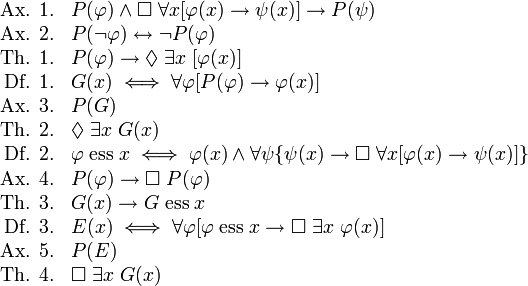
The proof of Gödel
The main innovation introduced by Gödel is to make explicit the possible assumptions that could previously be implicit, and using the formalism and methods of modal logic, that is the kind of logic which takes into account the "mode" statement is not only true or false, but it may be true in a way necessary or possible (ie its negation is not necessary) or quota (that is not necessary neither it nor its negation), or otherwise.
simply, the line of the proof of Gödel part by formally defining the concept of "positive properties." Intuitively, this is the classic attributes, or perfections, such as omnipotence, immortality, justice, compassion and so on. But of all this, as in Gödel, no mention is made. Describes the positive properties in the abstract, calling as it does for mathematical entities. We declare that the union of two positive properties is still a positive property, that if something is not a positive property then so is its negation, and so on.
God, or rather the property that G is interpreted to mean "being god", is thus defined as property which is to have tutte le proprietà positive.
Vengono inoltre dati alcuni assiomi, i veri e propri punti di partenza del ragionamento, tra cui per esempio il fatto che l'“esistenza necessaria” sia una proprietà positiva, e che ogni proprietà che sia conseguenza di una proprietà positiva sia a sua volta positiva.
A partire dalle definizioni e dagli assiomi si sviluppa una serie di passaggi che, pur costituendo la dimostrazione vera e propria, paradossalmente ne sono la parte meno interessante e più tecnica rispetto all'impostazione generale e agli assunti scelti per dare il via al ragionamento. Applicando gli strumenti della logica modale si deduce dapprima che è possibile che esista qualcosa che ha la proprietà G, and then that it is possible that there is then necessary. Therefore, God exists.
What's wrong?
One of the merits of the transaction by Gödel, is to have fully explained the terms that are used in this type of demonstration, and relations between them. To quote Robert Even, "in every case the work to formalize and, therefore, for clarification, made by [Gödel] is worthy of admiration, even though it seems to me, by these concepts is unlikely to tear out out something relevant." Indeed, beyond its merits, the proof of Gödel suffering in much of the same type of defects in all other ontological proof that preceded it, flaws that Kant had already highlighted.
Firstly, the starting point of reasoning, that the axioms that are taken as the basis for everything else, I'm not really much more obvious or easy to accept conclusions that are drawn. It was also noted that although the axioms do not lead to formal contradictions, could lead to a contradiction when interpreted in terms of moral or physical, for example you can not agree that the union of two positive properties is still a property positive, or is even conceivable (as happens with attributes that are not fully compatible as transcendence and the ubiquity).
is also difficult if not impossible, to move from the purely abstract world of logical ideas to the concrete existence of something (god, in this case) and deducting this from them. And it is already questionable considering the fact of existence itself as a property or perfection. For many philosophers it is simply a case of the copula, the verb "to be" in a sentence. Finally
many, even believers would not share the concept of God described by this type of demonstration, or even would disagree with the idea that it is impossible to define in human terms the essence of a god, much less, then manipulate it with formal proceedings.
Gödel and god
So how is it possible that one of the greatest minds of the twentieth century has fallen into the age-old temptation to solve a problem with methods that land by its very nature does not lend itself this approach?
First of all, we're talking about a private appointment. It is likely that only a little over a year, a formal analysis of a certain reasoning, Gödel referred merely to highlight the structure and explain the content, in the light of the language and methods of modal logic.
Secondly reasoning of this kind, ranging from purely the metaphysical sense, is an expression of a certain mindset, brought to an extreme. In logic, if a formal system (a set of symbols and rules to manipulate them) does not contain contradictions, that is if you can not deduct both inside a statement is its negation, then in some sense, this system exists. Typically, this existence is completely abstract: it is possible to construct a "model" that develops the mathematical properties of that formal system. Normally you do not intend that there is some physical object - or metaphysical - described by the formal system. In the same spirit, it seems that Gödel was interested in studying the non-contradiction - and then, in theory, possibility - of various scientific theories and not, including spiritualism, survival of the soul, and so on.
Finally, it appears that Gödel considered himself a theist and actually had a keen personal interest and, we might say, a very open-minded towards many other possibilities in life beyond death and the transmigration of souls to paranormal phenomena. On this we can not say much, because Gödel tended to be coy about his personal views and very rarely expressed in public, most of what we know comes from testimonies from friends or from private correspondence, including letters in which the mother warned of the potential in this boastful field.
I would like to conclude with a quote from Gödel's notebooks: "dedicated to the philosophy is healthy in any case, even when it does not show any positive result (but I remain baffled). It has the effect that "the color looks brighter," that is the reality that appears more clearly as such. "
Further Reading
Main is demonstration that the real place that work and in life and in the history of Gödel's ontological proof, it is valuable the volume Kurt Gödel, The mathematical proof of the existence of God , edited by Gabriele Lolli and Piergiorgio Odifreddi (Bollati Basic Books), where the text of the demonstration and the other for scarce notes taken from the notebooks of Gödel is accompanied by useful in-depth essays, includes an article of the great mathematical logician and philosopher, a true "master lay," which was mentioned Maybe Roberto, founder of the magazine among other neo-Enlightenment Doubt .
The possible incompatibility of divine properties between them, which was mentioned above, see the article by Theodore M. Drang, "Incompatible-Properties Arguments: A Survey" (published in the journal Philo and now available online at http://www.infidels.org/library/modern/theodore_drange/incompatible . html).
To learn about the work of Gödel in general and in particular its incompleteness theorems, advice The proof of Gödel Ernest Nagel and James R. Newman (Bollati Basic Books) and the ride through logic, art and music that is Gödel, Escher, Bach di Douglas Hofstadter (Adelphi).
(Fonte dell'illustrazione: http://en.wikipedia.org/wiki/Gödel's_ontological_proof )


0 comments:
Post a Comment