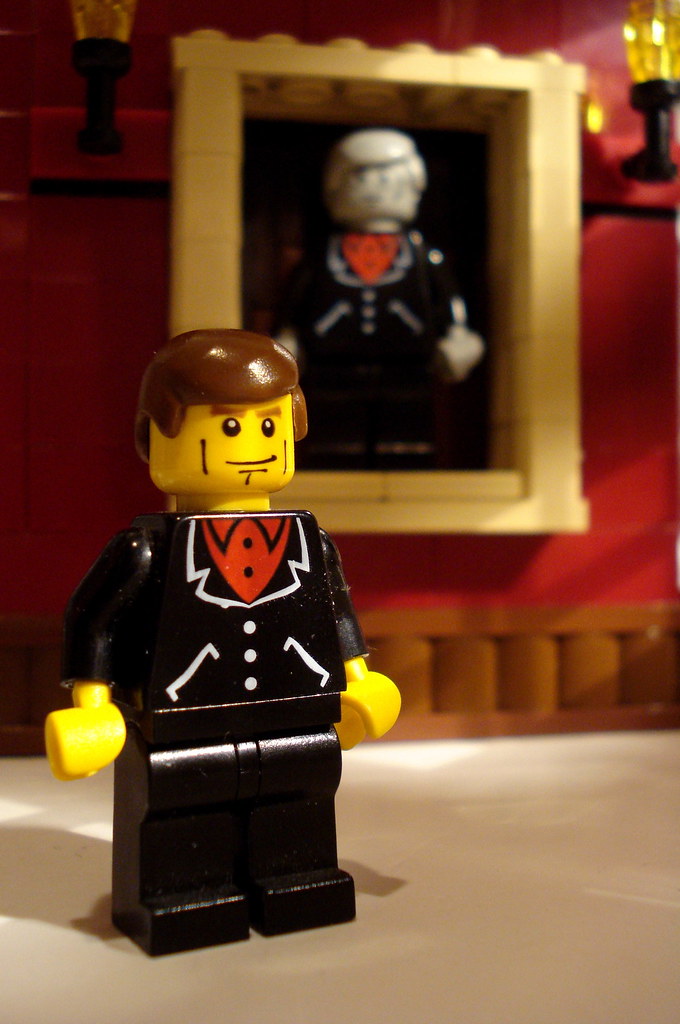
I recently read The Picture of Dorian Gray Wilde and I saw two films that were taken, one in 1945 and another in 2009.
there are at least a dozen film versions , including a Hungarian in 1918 with Bela Lugosi and a German-Italian-British 1970 with Helmut Berger of whom it was said: "One of the Most Interesting Things Dallamano does with Dorian is to wrap Him In Zebra fur. Dorian has zebra drapes on windows and zebra His His fur rugs on floors. By the end of the film Dorian is dressed in a floor length zebra fur coat that would make many pimps in 1970 envious.” (“Una delle cose più interessanti che Dallamano [il regista della versione con Helmut Berger] fa con Dorian è rivestirlo di pelli di zebra. Dorian ha tende di zebra alle finestre e tappeti di zebra sul pavimento. Prima della fine del film Dorian indossa un cappotto di zebra lungo fino ai piedi, che avrebbe reso invidiosi molti papponi del 1970.”)
Di per sé, che un adattamento cinematografico segua più o meno pedissequamente il romanzo che lo ha ispirato ovviamente non dice ancora nulla sulla qualità del film. E non dice molto neppure sulla “fedeltà” understood in a general sense. After all, fiction and film are different languages, have time, methods, different syntax: a movie so it can keep some of the spirit of the first book while taking various liberties with the letter of the text. I have heard repeatedly quote Lord of the Rings Peter Jackson as a positive example in this sense, and agree.
What happens from this point of view, these two incarnations of Wilde's novel on celluloid?

The Picture of Dorian Gray of 1945 was written and directed by Albert Lewin in the United States, which for most of His career was mainly writer, proofreader and executive producer of screenplays: the protagonists are Hurd Hatfield in the title role and George Sanders in one of his cynical mentor, Lord Henry Wotton (and Angela Lansbury, a young, plays Sybil Vane, the first woman loved by Dorian). In Dorian Gray British in 2009 the two are played respectively by Ben Barnes (best known as Prince Caspian of Narnia) and Colin Firth : The writer is the newcomer Toby Finlay, while the director Oliver Parker has turned half a dozen films including two productions of Oscar Wilde.
version of 1945 is considerably higher. There are two aspects of the cinema of that time and place that played to its success. These are two aspects that are a priori limits on the freedom of those who make a film: black and white (but this talk about it now) and the Hays Code (and this talk about shortly).
version of '45 is in a beautiful black and white, with shots of the elegant mansions of Dorian and other characters and sinister shadows that cut the scenes of our infamous local frequents in his pursuit of pleasure. The film is one - actually, two - a concession to effettaccio to hit the viewer: The first time you see the portrait of hero, perfect in his youth and beauty, and then again when it reappears years later, turned up to the age and vices beyond recognition, we see him briefly in the splendor of Technicolor. Even if he wanted to show more explicitly the moral degradation of Dorian Gray, at that time would not have been possible.
Notoriously the Hays code, or more properly the "Motion Picture Production Code" , imposed tight limits to the topics that could be mentioned in a movie, and the world in which they could be shown. In particular, any allusion to sex was out of the question. Even a married couple could not be shown together - even sleeping - in a double bed, not to mention adultery, homosexuality, perversions ... But in this case, I find that the prudishness of the Hays Code and the Victorian morality of the time of Wilde's well-tuned form a union: the first works to preserve the oblique allusions, ellipses, due to the brief fleeting second and good taste of Wilde .
For example, in the novel it is said that
Women who HAD HIM wildly adored, and for His sake HAD braved all social complaints and September convention at defiance, Were seen to grow pallid with shame or horror if Dorian Gray Entered the room.
(Women who had passionately adored [Dorian Gray] and he had faced criticism and challenged the conventions of society, were seen pale with shame or horror if Dorian Gray entered the same room.)
And in the 1945 film is shown in this particular situation .
 Another striking moment of the same film is one in which Dorian is in a place where he is waiting for something disreputable. Listen to imagine a pianist until he opens a door that frames a scale almost expressionist going upstairs: our crosses its threshold, imagine the following, and closes the door behind him. End of scene.
 The films of 2009, invece, è infinitamente impaziente e anche didascalico: in una situazione analoga ci mostra con gran copia di nudità e umori che cosa succede al piano di sopra. Paradossalmente, sembra un film - per così dire - per bambini. Un adulto può immaginare il tipo di posti in cui Lord Henry porta Dorian per fargli conoscere la vita e i suoi piaceri, ed è a questo adulto che parlano il romanzo e il primo film. Il secondo film invece parla al distratto che, figuratamente, dice: «Dov'è che lo porta? Al circo?», e gli mostra un bordello con dovizia di dettagli. Ovviamente, non c'è niente di male nel mostrare l'interno di un bordello vittoriano, e in altre circostanze può essere un soggetto interessante. Ma qui è, paradossalmente, misleading to the story it tells. Indiana Jones If you grab a vine to escape a trap, Spielberg makes little about the biological mechanisms that led to the formation of this species of plant with vines.
The vines are to Indiana Jones to save and to continue the story, as well as local misconceptions serve to Dorian Gray for damage and to continue the story.
But the worst thing is that being so explicit is a little 'how to explain the jokes ...


0 comments:
Post a Comment